
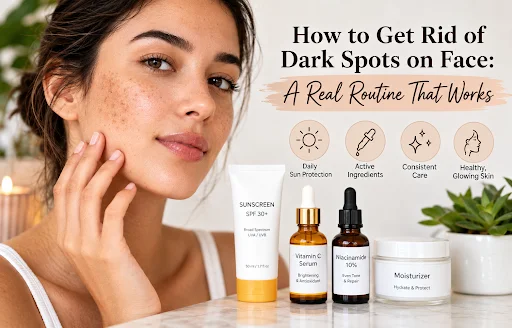
You’re under bathroom lighting, the worst kind, and there it is that spot near your cheekbone concealer never quite hides. Maybe it showed up after a breakout last spring. Honestly, I can’t remember. You’ve tried something for it already and it didn’t really work.
Nobody tells you this in the first five minutes at the skincare counter: dark spots fade, but only if what you’re using actually matches what caused them. Slather vitamin C on a melasma patch that birth control triggered, and you’ll just be disappointed for a year straight.
What Causes Dark Spots on the Face?
Dermatologists call it hyperpigmentation basically, one patch of skin decided to pump out more melanin than the rest. Three main things cause it, and most people never actually figure out which one they’ve got.
The sun does most of the damage. UV exposure makes your skin churn out extra pigment as a defense move, and after years of skipping sunscreen, that pigment starts clumping cheeks, forehead, backs of the hands if you were really careless about it. Spent your twenties tanning instead of burning and felt smug about it? Yeah, this is where that catches up with you.This is the bill coming due.
Then there’s the picked pimple, the cut, the bad reaction to some new serum, any of it can leave a mark once skin heals over. Post-inflammatory hyperpigmentation, technically. Hangs around longer in medium to deep skin tones than people expect. It can fade on its own, sure. “Eventually” though. Sometimes that’s a full year.
And hormones pregnancy, the pill, anything that messes with your hormonal balance can trigger melasma. Larger blotches on cheeks and lips as opposed to small dots. Same ingredients treat it as everything else, but melasma’s the moody one. Comes right back the second sun or hormones shift again.
How to Get Rid of Dark Spots on Face with Proven Treatments
Hydroquinone’s still the gold standard, full stop. Shuts down melanin production right at the source. A 2023 review of the clinical data backs that up. Annoying catch though FDA locked it behind a prescription in 2021, so anything past the weakest version means a dermatologist visit. Give it five to seven weeks before expecting to see much, three months to a year for the full effect.
Retinoids get pigmented cells to turn over and move out faster. Over-the-counter retinol is the slow lane. Prescription tretinoin’s quicker but takes three to six months and dries your face out early on if you’re not careful. Start at two or three nights a week, go all in night one and you’ll just end up flaky, not glowing.
Vitamin C and niacinamide keep showing up together in every brightening serum for a reason they actually work well as a pair. Vitamin C gets in melanin’s way. Niacinamide calms things down and patches up your skin barrier, which matters more than people think since irritated skin just makes more pigment. Neither’s fast. These are both mild enough for you to continue using them long after the spot has disappeared, simply because you want to maintain that state of affairs.
Chemical peels such as glycolic acid, lactic acid, and salicylic acid help to remove the “glue” holding dull and discolored skin cells to the top layer of your skin. With two to three uses per week, you will notice smoother skin underneath. Every day, and you’re just irritating yourself into worse pigmentation. More isn’t the move, whatever the bottle’s marketing says.
One more thing, while we’re on products: some cheap imported “miracle” correctors have turned up with unlisted steroids or mercury hiding in the formula. None of it’s on the label. Both can thin skin for good or leave permanent discoloration. Stick to stuff made in the U.S., or ask a dermatologist first, and run from anything promising results in days. Real fading takes weeks. Annoying, but true.
When Your Bathroom Cabinet Isn’t Cutting It
Spot’s been sitting there over a year despite doing everything right? Might be time for something stronger. Chemical peels strip off the top layers with a heavier acid smoother skin that grows back over a few sessions, some redness in between. Laser and IPL go straight for the pigment with concentrated light. Faster, but pricier, and not risk-free deeper skin tones especially can end up with darker patches if whoever’s running the laser sets it wrong. Not the place to shop for a discount. Microneedling’s gentler, prompts skin to rebuild itself, helps with shallow pigmentation and texture together.Whatever route you pick, get a licensed dermatologist. Not a Groupon deal.
The One Step You Cannot Skip
Sunscreen. Broad-spectrum, SPF 30 minimum, every day not just when you’re at the beach. The American Academy of Dermatology has said this outright: sunscreen, daily, is what keeps spots from darkening and keeps new ones from forming in the first place. Not a serum, not a trend. Sunscreen. Reapply if you’re out more than a couple hours, and don’t trust your foundation’s built-in SPF. Most people don’t apply nearly enough of it to hit the number on the label anyway.
How Long You’re Actually Looking At
Here’s the annoying part: most hyperpigmentation takes six to twelve months to visibly fade, even doing everything right. Deeper spots, longer still. Two weeks into a new serum with nothing to show isn’t failure. It’s just how slow this is. Snap a photo on day one, same lighting, check back at one month and three months beats squinting at your face every morning hunting for progress that isn’t coming that fast.
Want a fuller routine, the actual order to layer everything so one product doesn’t cancel out another? healthandbeautytrend.com’s skin glow tips guide walks through it.
When This Stops Being a Skincare Problem
Most dark spots are purely cosmetic. But get one checked if it changes color, changes size, has weird borders, shows up overnight, or starts itching, bleeding, or tingling. None of that’s typical hyperpigmentation behavior, and catching melanoma early is basically the whole game.
FAQs
Prescription hydroquinone plus daily SPF 30+, realistically. Five to seven weeks for visible change, months to fully fade. Lasers move faster but cost more and carry more risk.
Sometimes usually the post-inflammatory kind, from a healed pimple. Sun damage and hormonal spots are stubborn conditions that really require an active approach along with daily sunscreen use.
It is possible because both of them work in different ways. Just do not start with both of them on day one.
Yes, if you slack on sunscreen. That’s the whole reason SPF stays in the routine even after the spot’s cleared, not just while you’re fighting it.
No shortcut here, no matter what the bottle claims. What actually works: match the ingredient to what’s causing the spot, give it months instead of days, and don’t skip sunscreen. Pick one product and stick with it. If you want help figuring out what pairs well together, healthandbeautytrend.com has some guidance.